







 Email updates
Verizon Song ID review and accuracy testing
The full name of the application is “Verizon V CAST Song ID”. It’s a free application from Verizon that you can load on many of Verizon’s MP3-capable cellphones. And, just like that, hold it up to music, and identify your song. Once the song is identified, Verizon gives you options for purchasing the entire song track, or a shorter ringtone. Theoretically, this sounds great. But to me it originally seemed to nudge a toe over the line marked “too good to be true”. So I decided to run a Verizon Song ID test process and see if Song ID can do what it claims. Does Verizon’s Song ID work? Here’s what I did to find out. I opened my current media storage program of choice: iTunes. I began playing my songs, one at a time, trying to let Song ID indentify each one. If a song wasn’t identified on the first try, I gave it one more try before I marked the song as unidentified. I originally wanted to attempt an ID for each song in my entire iTunes collection of 305 songs. However, I stopped after 108. This is because, by that point, the scanning and ID process was behaving in a predictable pattern. I of course can’t predict how Song ID will work in every situation, but I tested it enough to 1) determine trends, and 2) define under what conditions it works the best. Verizon V CAST Song ID: Test and analysis Let me give the quick numbers, and then I’ll detail my Song ID test and how it might work for you. I tested 108 songs. Verizon V CAST Song ID was able to identify 76 of them. BUT, this is not the final score. Keep reading… This is a low score until you take into account that many of my songs are certainly considered arcane. I honestly don’t expect a song identification service to know about old CDs created by independent musicians or MP3s released by some anonymous person on the Internet. In my case, these include music from the old TV show “Mystery Science Theater 3000”, or tracks from the demo album of the not-safe-for-the-easily-offended Stephen Lynch, or the Internet-only release of "The Picard Song" by DarkMateria. Again, I wouldn’t expect a music ID service to be able to identify everything I listen to. And if you remove the “unfair” songs, the songs that simply aren’t available in major outlets, the final score changes. Removing the “arcane” stuff in my collection gives a success rate of 76 identified out of 84 total songs. So, my adjusted Verizon Song ID accuracy: 90% Not bad at all. Next, we examine: of the songs that were missed, were there any patterns to them? Yes, I found certain types of songs were just not easily identifiable.
A small note about the album ID: Your artist and song may be identified correctly, but the album might be wrong. Since songs from one album can be exactly the same on another, I think this is understandable. It’s not important to me, but I still wanted to mention it. This happened with perhaps five or ten songs, including “Sinnerman” by Nina Simone, “Flash’s Theme” by Queen, and “Purple Haze” by Jimi Hendrix. Verizon V CAST Song ID: Conclusion What does all this mean? It means something very important: If you are trying to identify modern mainstream music, Song ID accuracy will be very close to 100%. If it’s on a pop radio station, if it’s by an artist still active today, chances are very good that Verizon’s V CAST Song ID service can identify it. I'm guessing this will apply to the majority of users. I was really impressed with the Song ID service. If you don’t know a song, it can indeed listen and help you out. It’s a free service, so you don’t even have to pay anything unless you decide to purchase a song or ringtone. For any Verizon user with a compatible phone, I recommend the V CAST Song ID application. What’s the worst that could happen? You’ll have a cool toy to show off at parties, you’ll better personalize your phone, and you’ll improve your music collection. |
|
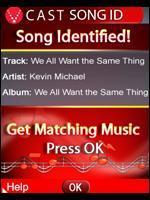 Verizon Wireless has a feature on their cellphones that sounds very cool: while listening to music, you can let your cellphone listen for a few seconds, after which it will identify the song, artist and album.