The Digital Bits Science Labs are fun science experiments for young children. Kids, make sure you have an adult's permission before trying any of these science experiments.
Digital Bits Science Lab
Science Experiments for Kids, Parents and Teachers
How to make your own rainbow, and meet “Roy G. Biv”
Description:
If you’ve ever wanted to make your own rainbow, it’s not difficult with a little experimentation.
Equipment Needed:
A flashlight
A large, wide glass (it should be as wide or wider than the head of your flashlight)
Water
The Digital Bits Science Lab Experiment:
In this experiment, we refract light from our flashlight through water. The light, when refracted in the right way, will separate the light into its component colors. The name “Roy G. Biv” is an easy to remember name. It’s also an acronym: ROYGBIV are the first letters of all the colors in a rainbow. The colors in a rainbow are red, orange, yellow, green, blue, indigo, and violet.
A rainbow is also an example of additive color mixing. Additive color mixing occurs when you mix together different colors of light. The light coming from the flashlight is our combination of all colors – it appears white. After shining it through our water, the water separates the white light into the colors that make it up.
To make a rainbow, I used a coffee pot filled with water. Then I placed it on the floor, and shone a flashlight through it, with the refracted light landing on a nearby wall:
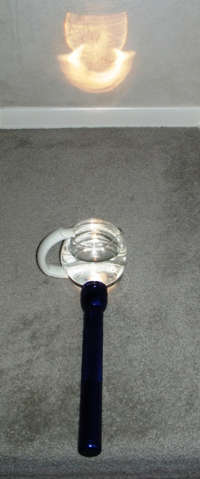
Next, you’ll have to play with the flashlight and the water. Move them around. Angle them differently. Move them closer to or away from the wall. The light pattern on the wall will change, and eventually, if you work it right, you’ll see a rainbow at the edges of the light pattern. While the setup you see pictured above worked pretty well, the rainbow picture below was taken by shining the flashlight from underneath the coffee pot, shining the light pattern on the ceiling:

Here’s a close-up of the rainbow picture. Look close, and say hello to Mr. Roy G. Biv!

Other articles related to this topic:
- Introduction to refraction
- Magnifying glass experiment: How does your computer and TV make colors?
- Color mixing with plastic tiles
- Learn colors and color combinations with food coloring
- Learn about colors, color combinations and chemical reactions with Color Dotz
it doesnt work 4 mee!!!!!
Amanda, I’m happy to help troubleshoot your making a rainbow, but I don’t know exactly what you did. Can you tell me if you did anything outside of what I mentioned above? What was your glass container? Was this tried with the lights out, or on? How far was the light from the glass?
For the record, making a rainbow seemed to work fine for me with a wider, larger glass container (in my case, a coffee pot), with the lights out (to better see the do-it-yourself rainbow), and the flashlight was very close to the glass (I believe it was actually touching it, and worked best when shining the light through the bottom of the pot.)
This was a great experiment. I used it to teach a class of 5yos about rainbows. They are not every patient with experiments that take a long time. This was easy and fun for them to try.
wow i would like 2 try dat nd see iof it would work for me
but do it work in a dark rrom
Yes, Tasha, it’ll work better if the room is darker.
this experiment looks easy i have a project to turn in 2morrom so thz
Thank you for sharing this idea. I was looking for a way to make rainbows come alive for my children’s sermon tomorrow, and this is sure to be a hit.
Roy G. Bivs name represents the colors of the rainbow. Red, Orange, Yellow, Green, Blue, Indigo, and Violet. I grew up haveing to learn the colors of the rainbow and I used Roy G. Biv.
This might help you some day if you are in need of a project fast.
this is a great project and so i used it for my 8th grade science fair expirement.. it workd out great and i would advise anyone to use it comment if u need help
This did not work for me. I put the flashlight against the coffee pot and with the lights out, all I got was a white reflection of the light, no matter where i moved the flashlight. I tried an led flashlight too, it didnt work either
I am going to use this project for a science demonstration it seems simple as a matter of fact I have done it before only in a different process.