The Digital Bits Science Labs are fun science experiments for young children. Kids, make sure you have an adult's permission before trying any of these science experiments.
Digital Bits Science Lab
Science Experiments for Kids, Parents and Teachers
How to make copper metal from dissolved copper compounds
Warning: Copper sulfate is poisonous if swallowed, and the blue color makes it very attractive to small children. Do not leave the crystals or solutions unattended around very young children, who may try to eat or drink them!
Description:
A lot of copper mines extract copper from ore by dissolving the copper minerals with sulfuric acid, producing copper sulfate solutions. This lab is one of the ways that they use to convert the copper sulfate into copper metal. Once the copper has been made into metal, it can then be melted down to make copper products like electrical wire.
Equipment needed:
Copper Sulfate. This is one of the most soluble copper compounds, it makes bright blue crystals and dissolves fairly easily in water. You can buy it in hardware stores in several forms, the form I found was Roebic Root Killer (used to clear roots out of sewers and septic systems).
Click the photo to view the larger-sized picture.
Steel wool. Use unsoaped steel wool (the type that is used for sanding varnish), the finer the better.
A small plastic or glass container (something small and disposable, like a yogurt cup, is good)
A plastic or wooden stirrer for mixing the solution (a coffee stirrer or a wooden skewer are both good. Don’t use a metal spoon to stir it, because it will plate copper onto the metal)

The Digital Bits Science Lab Experiment:
Put a spoonful of copper sulfate into the container, add water, and stir until the copper sulfate dissolves.
Tear off a piece of steel wool that is about the same volume as the copper sulfate that you added to the solution:
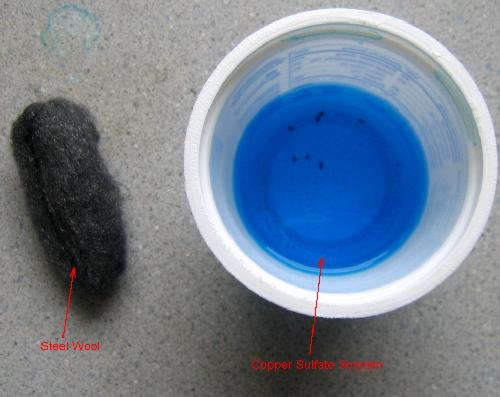
Put the steel wool into the copper sulfate solution. Use the stirrer to roll it around so that the solution flows through the steel wool. If you use the stirrer to pull the steel wool to the surface of the solution after about a minute, you should see that the steel wool is turning copper colored.
After about 30 minutes, the steel wool should disintegrate into a powder, while the solution changes from blue to green. If you carefully pour off the liquid, you should be able to keep the powder in the bottom.

The powder, which should be reddish-brown, is metallic copper powder. If you dry it and check its conductivity with a multimeter, it should be electrically conductive. If it were just rust from steel wool, it would not conduct electricity after it dries.
What is going on here?
We are starting with copper sulfate in solution (CuSO4), and metallic iron (Fe). It turns out that copper as metal is more stable than iron as metal, so when we put metallic iron into copper sulfate solution, the metal atoms basically switch places:
(Dissolved CuSO4) + (Metallic Fe) ==> (Dissolved FeSO4) + (Metallic Cu)
In the copper mining industry, this process is called “cementation”, and is still used by copper mines that can buy scrap iron cheaply.
Other articles related to this topic:
- How to electroplate copper
- Multimeter experiments with electricity and water
- Learn about a compass and earth’s magnetic poles
- 1 cup and 1 cup does not make two cups – Experiment with solutions
- Kinetic energy transfer with a drum and drumsticks
Thanks so much. This explained the experiment so much better than the chemistry set we bought that had NO copper sulfate after we spent hours researching it for a school science experiment. We will visit a hardware store tomorrow. Thanks again!
i want to know that how can i prepare cuso4 ,that it could not be dissolve in water nor acid thanks
how can i prepare cuso4 , that no acid should affect cuso4 or water should alsoi not affect it? thanks.
Why doesn’t the iron get oxidized all the way to Fe3+ (Ferric ion)? Why does it stop at Fe2+ (Ferrous)???
Thank you very much for the information. I am thinking to produce the same on commercial level. Can u suggest me any website which help me in giving detail information for
1. Copper Ash to Copper Powder
2. Copper Powder to Copper Sulphate
3. Nickel Scrap to Nickel Chloride
4. Nickel Scrap to Nickel Sulphate
5. Nickel Scrap to Nickel Carbonate
6. Chromic Acid
7. Zinc Oxide
which is having big market (less risk)but profitable.