The Digital Bits Science Labs are fun science experiments for young children. Kids, make sure you have an adult's permission before trying any of these science experiments.
Digital Bits Science Lab
Science Experiments for Kids, Parents and Teachers
1 cup and 1 cup does not make two cups – Experiment with solutions
Description: This experiment shows how mixing ingredients into a solution doesn’t double your final result. In this case, you may get much less than what you expect.
Equipment needed:
Two measuring cups (one cup must be able to hold at least two cups)
Water
Sugar
One spoon
The Digital Bits Science Lab Experiment:
Make sure that your cup of water and your cup of sugar are filled up precisely.
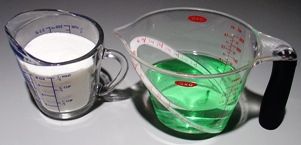
What do you think will happen when you pour the cup of sugar into the cup of water? You might think that you’ll get a result of two cups of a water/sugar mixture. Let’s try it: Pour the sugar into the water. Stir with the spoon.

Note what happened: one cup of sugar added to one cup of water does not give us two cups!
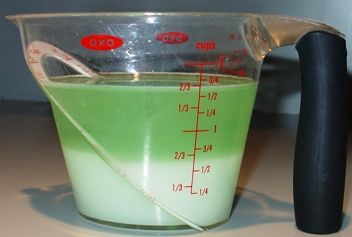
What’s happened? Why does one plus one not make two? We’ve created a “solution”, and this has interesting properties. A solution is when you mix ingredients, and those ingredients may undergo a physical change as part of that mixing. In this case, our sugar changes physically. Much of it dissolves in water. This is happening on a molecular level – the sugar seems to take up less room, because it’s using the extra space between the water molecules! The density of the water is greater now – we have more molecules crammed into the same space.
On a big scale, this is how the Earth’s oceans are salty, even though we can’t see that salt. Water looks like it may take up a lot of space, but there’s plenty of room to share.
Other articles related to this topic:
- Multimeter experiments with electricity and water
- How to make copper metal from dissolved copper compounds
- Hot air takes up more space than cold air
- Why is it easier to swim in the ocean? Learn about buoyancy.
- Food coloring fireworks with oil-water separation
Granulated sugar into fluid. Of course it won’t raise the level of the fluid by the physical height of the granulations. Think about how steel balls would fare. A significant volume of the granulated material is empty space. The notion of the dissolved sugar’s requiring less volume is vanishingly small in comparison to the lessening of volume by simply filling in the empty spaces between granules.
You can pour water into the 1 cup of sugar granules and lower the volume of the container similarly.
I find the explanation here inadequate.
Hi Peter,
Thanks for the more detailed explantion, and for taking the time to write. It’s effort like this that will improve the articles for all future readers.
I have to agree with Peter on this one. I think what you’re actually seeing here is how much “air space” is between the individual sugar granules. The explanation tries to make it a bit more complex than it actually is.
If you were to do this same experiment with grains of sand that were a similar size as the grains of sugar, the results would be nearly identical. The sand would not break down at the molecular level, or even “melt.”
It’s the volume of air being displaced as the sugar becomes a solution that makes the difference, not any physical changes in the composition at a molecular level.
A more telling experiment would be to take 1 cup of regular granulated sugar (570-635 microns) and one cup of similarly sized glass beads. Add a cup of water to each, and see the results. My belief is that they would be similar, with a slight variation wherein the sugar levels would be slightly lower than the glass bead levels. Not because of the solution created, but because the shape of sugar grains are odd, not allowing for a packing as dense as the perfectly round glass beads.
How about using alcohol and water? That would eliminate granularity from the equation, while still producing a reduction phenomenon.