The Digital Bits Science Labs are fun science experiments for young children. Kids, make sure you have an adult's permission before trying any of these science experiments.
Digital Bits Science Lab
Science Experiments for Kids, Parents and Teachers
Hot air takes up more space than cold air
Description:
When heated, air will expand. When cooled, air will compress. Hot air takes up more space than cold air, as this experiment demonstrates.
Equipment needed:
A balloon
A plastic soda bottle (a 2-liter will work well)
Duct tape
A soup pot
A stove
Water
The Digital Bits Science Lab Experiment:
Pour some water into the bottle. Three inches or so will be plenty.
Pull the ballon over the mouth of the bottle. The balloon should be deflated at this point. Wrap a strip of duct tape around the balloon-bottle connection, to make sure the seal is close to airtight.
Fill the soup pot with water. An inch or so will be plenty.
Put the bottle in the soup pot. Put the pot on the stove.
Turn on the stove. You should have something that looks like this:
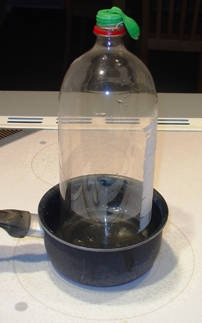
Wait for the water in the pot to heat up. As it does, the water in the bottle will heat, too. The balloon will eventually inflate:

What’s happening? This science experiment demonstrates how air, when heated, will expand. It expands because air molecules move around a lot more when warmed up. Since they’re moving around more, they bounce around and off each other, and take up more room. We see this as the balloon expands.
To see the opposite of this effect, take the bottle-balloon invention off of the stove. Place it in a container full of ice, or stand it up in a freezer. The balloon will shrink back down and deflate, and the bottle itself might compress inward as the air gets colder!
Another question that people may have is, “why doesn’t the plastic bottle melt on the stove?” Here’s an experiment that shows why the bottle won’t melt, because the water conducts the heat away from the bottle.
Other articles related to this topic:
- Heat conduction with water, balloon and candle
- Learn about air pressure from a leaky bottle
- Build a balloon-powered mini-hovercraft
- How to join and separate two streams of water – surface tension in action
- How to separate salt and pepper
Oh! I think this will work well but you can also do this with “bicarbonato de sodio” (I don’t know how to write it in english) and vinegar, it gaves the same results, try it
from El Salvador: Martha
this was my science project and it helped a lot!!
This truly was what I was looking for. This helped me soo much!!