The Digital Bits Science Labs are fun science experiments for young children. Kids, make sure you have an adult's permission before trying any of these science experiments.
Digital Bits Science Lab
Science Experiments for Kids, Parents and Teachers
Why is it easier to swim in the ocean? Learn about buoyancy.
Description:
Learn about buoyancy. This lab answers the question: Why is it easier to swim in the ocean than in a lake?
Equipment needed:
An egg (it can be either raw or hard-boiled. It needs to be fresh.)
A tall, wide glass
Water
A long-handled spoon for stirring in the glass
Salt (you’ll need a lot of salt, more than what’s contained in a salt shaker. If you’re purchasing for a group or class, shop for salt in bulk
.)
The Digital Bits Science Lab Experiment:
Carefully place your egg in the empty glass. Then fill the glass with water, leaving an inch or so of space at the top. You’ll see that the egg sinks, and rests happily at the bottom of the glass. (If your egg floats in the fresh water, that’s an indicator of an old egg. Use a fresh egg instead.)
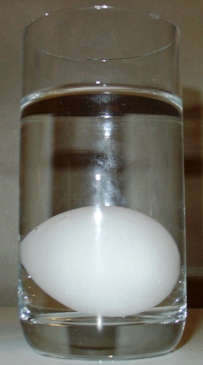
Now that we’ve seen the egg sink, use the spoon to carefully lift the egg out of the glass.
Next, pour salt into the water.
Keep pouring.
And pour a little more.
Stir it.
The goal is to get so much salt in the water, that you can’t dissolve any more. Stir the mixture for a while. If you lift the spoon out after stirring, and still see a few salt grains clinging to it, your salt-water mixture is ready.
Using the spoon, carefully lower the egg into the water. If you’ve mixed enough salt in the water, the egg will now float!

The egg floats in the salt water because it has more buoyancy in salt water than in fresh water. Buoyancy is determined by the density of the water. Fresh water is not very dense. Things will sink easier in fresh water. Salt water consists of water mixed with a LOT of salt. That salt adds density to the water. So when you put the egg in salt water, the heavier density of the water causes the egg to float.
This is why it’s easier to swim in the ocean than in a lake: the ocean is salt water, a freshwater lake is not. Your body is more buoyant in the higher-density salt water, and you can more easily float.
Other articles related to this topic:
- Why does a boat float? Experiment with buoyancy.
- 1 cup and 1 cup does not make two cups – Experiment with solutions
- Easy electrolysis – how to make your own hydrogen
- Learn about volume and space with ice water
- Multimeter experiments with electricity and water
What is with salt for increasing the density of water?
Regie, not sure what you’re asking, so I’m going to rephrase your question:
“How does salt increase the density of water?”
In order to understand this question, you need to understand the concept of a solution: a solution is a mixture of two different substances – one often being a liquid. In our solution of water and salt, the water dissolves the salt. But that doesn’t mean the salt is gone. The salt is converted into a solution with the water. You can’t see it, but it’s still there, taking up space in the water. The more salt we add, the more space the salt takes up. The more space the salt takes up, the more dense the solution becomes.
The short version: Adding salt to water makes the solution more dense.
Mijn vraag is: wie vertaalt deze teksten want er klopt geen hout van. Het door een computer laten vertalen levert nogal komische woorden op. Bv.: verlaat een antwoord komt van leave a message. Neem ik tenminste aan. Correct vertaalt is dat: laat een boodschap achter.
Het experiment omtrent het drijfvermogen van een ei in zout water is leuk.
Hi m.ernst!
I don’t speak Dutch, but here’s what my automated translator estimates you said:
“My question is: who translate these texts because there is correct no wood of. By a computer leave translate produces rather comic words. E.g.: leaves an answer comes of leave a message. I adopt at least. Correctly translates is that: a message leaves behind. The experimenting on the buoyancy of an egg in salt water is nice.”
I think I understand your question. Essentially, how is the translation done for this site? The answer is: automation. I use a tool that uses automated translating techniques. This exposes the website to more people than if it were English-only. However, I agree with you: It’s not always accurate!
For m.ernst’s benefit, courtesy of BabelFish, here’s a translation to Dutch of my response:
Ik begrijp uw vraag. Hoe wordt de vertaling bereikt? Het antwoord: automatisering. Ik gebruik een hulpmiddel dat paginavertaling automatiseert. Dit stelt de website aan meer mensen bloot dan als het Engels-slechts was. Nochtans, ga ik akkoord: De vertaling is niet altijd nauwkeurig!
I want to know if a raw egg and a boiled egg weigh differently if yes why, also whether they will behave differently in water?
Rashmi,
I think the best way to answer that question would be to get a couple of eggs and try!
Andy
Why does this experiment work?- Why does the egg float?
this isn’t true. i put eggs into the water and it still floated without the salt.
Eilegna,
The only explanation I can offer is that the egg you used may not have been fresh – if the egg starts to go bad, you’ll get gas buildup inside, and that could lighten it enough to float.
Andy